Democratic Tax Alternative
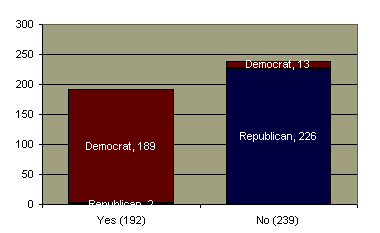
House - December 8, 2005

Democrats voting no: Barrow, Bean, Boren, Costello, Kanjorski, Marshall, Matheson, McCollum (MN), Murtha, Oberstar, Peterson (MN), Sabo, Visclosky
Republicans voting yes: Leach, Wilson (NM)
Independent voting yes: Sanders
Republicans not voting: Brown-Waite, Ginny, Hastings (WA)


The push to cut taxes - an annual rite for the Bush presidency - is facing a tougher sell in Congress, as concern grows about swelling deficits and budget cuts that target programs for the poor. See story from Christian Science Monitor The House budget-cutting bill has left countless groups--especially those advocating on behalf of the poor and the environment--devastated by what they say is irresponsible favoritism of rich individuals and corporations. See story from One World Net House Republican leaders were dealt a rare defeat as Democrats and 22 Republicans teamed up to kill a major health and education spending measure. See story from New York Times The U.S. Senate voted to extend $60 billion in tax cuts for individuals and businesses but added a $5 billion tax on big oil companies, drawing a veto threat from the White House. The Senate dropped provisions that would have kept in place tax-rate reductions for capital gains and dividends beyond their expiration in 2008. The Senate bill also extends a number of tax breaks for business, education and savings that otherwise would expire at the end of the year. Among them is a $30 billion measure that would keep millions of taxpayers from paying the alternative minimum tax next year -- a tax originally intended for the very wealthy. See story from Leading the Charge, Australia See vote In debating the tax cut legislation, the Senate approved a measure urging reinstatement of "pay as you go" financing of government (see vote), a resolution which would prioritize health care for children over tax cuts for the wealthy (see vote), and an amendment which would repeal tax breaks for the wealthy (see vote). Death Penalty Exactly 229 death-row inmates have been granted clemency since the United States reinstated capital punishment in 1976, and the list of reasons is short. The 16 governors who have given such pardons cited just three reasons: lingering doubt about guilt, a governor's own philosophical opposition to the death penalty, and mental disability of the accused. Starkly absent from the list - notable because of a high-profile clemency request now pending in California - is character reform of the guilty. See story from Christian Science Monitor Drug Policy Cocaine use among young adults in Britain and Spain is almost as prevalent as in the United States and consumption of the drug is rising across Europe. About 9 million people in the European Union, 3 percent of all adults, have tried cocaine, while up to 3.5 million are likely to have to have used it in the last year and 1.5 million took the drug in the past month, the report found. See story from Deutsche Welle Economic Inequality The evaporation of higher paying manufacturing jobs puts into focus two divergent attitudes toward the future of the U.S. economy. One view, espoused by free-market disciples, is that the nation's prosperity hinges on its extraordinary flexibility in deploying labor and investment. That explains its edge in job creation compared with Europe's tepid performance. But it comes with difficult adjustments, such as the one Delphi faces. The other side contends that as global competition grows stronger, flexibility alone isn't enough. They call for new policies to help retain and build middle-class jobs. The recipes vary, but they generally urge keeping a closer watch on whether free-trade policies are fair, fixing a hodgepodge health insurance system, and greater public investment in promoting new industries. See story from Christian Science Monitor While Alan Greenspan has won praise for his successful 18-year battle to keep inflation under control, he's the first to say he's had a lot of help. Among those most responsible are tens of millions of workers in China, India and Eastern Europe. Adding all those workers to the global economy has made the Federal Reserve's inflation-fighting job easier by increasing competition. That has helped hold down labor costs -- the biggest single expense for employers -- and, as a result, prices. But workers have been the losers as wages have become stagnant, manufacturing jobs have been lost and economic inequality has soared. See story from Associated Press A steady decline in the power of labor unions in the United States and most of Europe has led to some speculation that collective organizing of working people to campaign for their rights may be turning into a relic. But many analysts say labor associations worldwide are regrouping and looking for ways to better respond to global economy. See story from Voice of America The Food and Agriculture Organization presented its annual report on the State of Food Insecurity in the world. The report presented a bleak picture: nearly six million children, it said, die every year from hunger and malnutrition. See story from Voice of America Environment Drilling deep into Antarctic ice, scientists have extended Earth's climate history by another 210,000 years. The new results, they say, drive home two key points: 1) today's atmosphere holds concentrations of carbon dioxide significantly higher than at any time in the last 650,000 years; and 2) the rise and fall in temperatures track the rise and fall in carbon-dioxide levels as tightly during this additional period as they have over the past 440,000 years. See story from Christian Science Monitor The National Environmental Policy Act - known as the Magna Carta of US environmental laws - is under intense political scrutiny. The requirements of this Nixon-era act have done much for environmental protection, its supporters say. NEPA also has acted as a "sunshine law," opening the political process involving such decisions to all Americans through "environmental impact statements" allowing for public comment. But the law has also been the basis for hundreds of lawsuits, in effect becoming a tool for activists to slow or kill many projects. NEPA also has greatly added to the cost of public works, energy development, and other beneficial projects, critics say. See story from Christian Science Monitor The organic food industry continues to grow in the United States. Organic products have moved beyond specialty stores and farmers markets into national grocery chains and discount retailers as consumers demand increases. See story from Voice of America Developed countries, taken as a group, have achieved sizable reductions of greenhouse gas (GHG) emissions, but further efforts are needed to sustain these reductions in gases blamed for global warming and cut them further according to a UN report. A large part of the reductions was achieved in the early 1990s in countries of Eastern and Central Europe undergoing transition to a market economy which included abandoning polluting industries. See story from UN News Center A new study finds that global warming is driving up rates of malaria, malnutrition and diarrhea... contributing to 5-million illnesses and more than 150,000 deaths a year. According to its lead author, Jonathan Patz of the Nelson Institute for Environmental Studies, most of those deaths and illnesses will occur in the world's poorest countries - the nations least responsible for the increase in greenhouse gases. See story from Voice of America Globalization While Alan Greenspan has won praise for his successful 18-year battle to keep inflation under control, he's the first to say he's had a lot of help. Among those most responsible are tens of millions of workers in China, India and Eastern Europe. Adding all those workers to the global economy has made the Federal Reserve's inflation-fighting job easier by increasing competition. That has helped hold down labor costs -- the biggest single expense for employers -- and, as a result, prices. But workers have been the losers as wages have become stagnant, manufacturing jobs have been lost and economic inequality has soared. See story from Associated Press Leaders of Asian and American nations at an economic summit in South Korea have an ambitious goal: revive negotiations on a new global agreement to reduce trade barriers - a move that experts say could add some $300 billion a year to the global economy and help lift millions of people out of poverty. But to do so, they'll have to counter faltering worldwide momentum for free trade. See story from Christian Science Monitor Immigration The U.S. Border Patrol has announced a change in the so-called catch-and-release-policy, whereby illegal immigrants from countries other than Mexico, captured at the U.S.-Mexico border were automatically released to await a court hearing. Very few ever show up for their court hearing and disappear into the underground of illegal workers in the United States. See story from Voice of America Iraq The Senate defeated a Democratic effort Tuesday to pressure President Bush to outline a timetable for a phased withdrawal of U.S. troops from Iraq. See story from Associated Press See vote The Senate did pass a measure requiring more regular reporting on the Iraq situation. See vote Israel/Palestine After the personal intervention of US Secretary of State Condoleezza Rice, Israel and the Palestinians have reached agreement on opening border crossings linking the Gaza Strip with Egypt, Israel and the West Bank. For weeks, agreement had been blocked by the Palestinians' demand for full control of the crossings and Israeli security concerns. See story from BBC Prime Minister Ariel Sharon's decision to leave the Likud party and start a new centrist one, the rightis-Likud is the result of what might be summarized as an inevitable split between pragmatists and purists. While the purists are holding fast to their dreams of having a "Greater Israel" that includes the West Bank and Gaza, the pragmatists - many of whom are joining Sharon - have come to view a Palestinian state in those territories as an inescapable conclusion. See story from Christian Science Monitor Political Reform Big money is buying influence in Washington these days on a scale seen rarely, if ever, before. After the terrorist attacks of Sept. 11, 2001, big-ticket defense contracts doubled, federal spending on those contracts jumped by $100 billion - and the number of lobbyists signed up to represent defense-industry clients spiked from 900 to more than 1,650. While California Congressman Randall Cunningham clearly crossed a legal line by trading legislative favors for personal gain, his case spotlights the intersection of money and politics in Washington, where most lawmakers dance along a vaguer line that divides political donations from less-explicit paybacks. See story from Knight Ridder Race Despite enormous wealth and various federal and social welfare schemes at work, the United States is failing to help millions of its people trying to get out of poverty, according to an independent United Nations rights expert. "Resource constraints have limited the reach of the assistance programs and social discrimination has aggravated the problems in many situations resulting in poverty clearly seen as a violation of human rights," Dr. Arjun Sengupta declared after visiting the United States last month Despite enormous wealth and various federal and social welfare schemes at work, the United States is failing to help millions of its people trying to get out of poverty, according to an independent United Nations rights expert. See story from One World Net "Resource constraints have limited the reach of the assistance programs and social discrimination has aggravated the problems in many situations resulting in poverty clearly seen as a violation of human rights," Dr. Arjun Sengupta declared after visiting the United States last month European leaders are watching with apprehension the violence spread across districts of France that are heavily populated by disaffected Muslims, in what European media call the "French intifada". Western Europe is home to roughly 20 million Muslims. The largest concentration -- about five million -- live in France. Belgium, Germany, Britain, the Netherlands and Italy also have large populations of Muslims. Many believe that the problem stems from a long history in Europe of identifying nationhood with ethnicity which has hampered the assimilation of immigrants, leaving second and third generations feeling persecuted and excluded. See story from Voice of America Religion There is a quiet revolution spreading among young European Muslim women, a new generation that claims the same rights as their Western sisters while not renouncing Islamic principles. See story from International Herald Tribune The defiant Somali-born lawmaker, Ayaan Hirsi Ali, who has been targeted for assassination by Muslim extremists remains steadfast in her belief that the Muslim religion must change. "If you want to integrate migrants and especially Muslims, then you will have to address cultural issues. People are talking, carefully, very carefully, about, 'Yes, there must be something in Islam that's not compatible with democracy. And yes, some migrants do have some cultural traits that are not compatible with modernity, that are not compatible with a society based on universal human rights principles.'" See story from Los Angeles Times Social Security Some experts are saying that Social Security reform will not protect those presently over the age of 55 when the issue is again revisited. See story from USA Today Stem Cell Research Regulatory agencies will be needed to oversee the use of stem cells when current experimental therapies are ready to be tested in humans. Scientists also told a meeting on the ethical, legal and social issues surrounding stem cell research that the potential new treatments for illnesses ranging from heart disease and diabetes to Alzheimer's and Parkinson's are still 5 to 15 years away. See story from Reuters Welfare The U.S. House of Representatives voted on Friday to cut $700 million from the food stamp program as part of a broad bill to reduce federal spending by $50 billion, despite objections from antihunger groups. Under the House plan, roughly 165,000 people who now automatically are enrolled in food stamps when they get assistance from welfare programs would lose their food stamps. The House proposal also would require 70,000 legal immigrants in most cases to wait seven years to become eligible for food stamps, rather than the current five years. See story from Reuters See vote Proposed legislation to control Medicaid spending is dividing Democrats. Many Democratic governors support the reforms while lawmakers oppose them. See story from Washington Post