|
What are the latest developments in the controversy regarding civil liberties?
The most significant development involves the relevation of the practices of the super-secret National Security Agency. In 2013, the extent of the NSA's secret surveillance programs was revealed to the public by Edward Snowden. According to the leaked documents, the NSA intercepts the communications of over a billion people worldwide and tracks the movement of hundreds of millions of people using cellphones. It has also created or maintained security vulnerabilities in most software and encryption, leaving the majority of the Internet susceptible to cyber attacks from the NSA and other parties. Despite the relevation, public opinion supported the renewal of the legislation which authorized this type of surveillance. 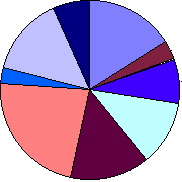 Nevertheless, the Senate did not have the sufficient votes necessary to extend the provisions of the Patriot Act which authorized this practice. Nevertheless, the Senate did not have the sufficient votes necessary to extend the provisions of the Patriot Act which authorized this practice.  Instead, with the passage of USA Freedom Act in June 2015
  , phone companies will retain the data and the NSA can obtain information about targeted individuals with permission from a federal court. The passage of this legislation also continued the other key provisions of the Patriot Act. , phone companies will retain the data and the NSA can obtain information about targeted individuals with permission from a federal court. The passage of this legislation also continued the other key provisions of the Patriot Act.
In the aftermath of 9/11, the U.S. Congress quickly passed the USA Patriot Act which is now the subject of some controversy. What provisions are causing concern? The provisions which are causing the greatest concern are the following:
"Domestic Terrorism" definition
The act creates a new crime, "domestic terrorism," which it defines as "acts dangerous to human life that are a violation of the criminal laws of the United States or of any State" and that "appear to be intended … to influence the policy of a government by intimidation or coercion." Concern: The broad definition may be used against any person or group exercising the right to assemble and to dissent.
Library and bookstore records
The FBI is permitted to seek information from bookstores and libraries regarding books purchased or borrowed and regarding use of library computers. Bookstore and library employees must not disclose that such information has been produced. Concern: Innocent researchers may suddenly find themselves suspects and librarians are required to become quasi-investigators.
Educational records
The attorney general may require an educational agency to collect educational records "relevant" to an authorized investigation of "domestic or international terrorism". Concern: The provision requires only that the information be "relevant" to a criminal investigation. This is a very relaxed standard and thus substantially undermines the privacy of educational records.
Searches Which are Not Judicially Supervised
The FBI has been provided the authority to gather "foreign intelligence information" without a warrant, unless the evidence sought is to be used in a criminal proceeding. The agent can now claim that foreign intelligence is relevant or plays a part in the investigation and "probable cause" of a crime is no longer necessary. Concern: The unsupervised authority infringes on constitutional safeguards against unreasonable searches.
Roving Wiretaps
This provisions extends roving wiretap authority to "intelligence" wiretaps authorized by the secret Foreign Intelligence Surveillance Court. The wiretaps can be made on any device used by a terrorist suspect, regardless of who is using the device at the time. Concern: The police can listen to all phones in areas where a person works, shops, visits, or even walks by.
Electronic Surveillance - Pen Registers or Trap and Trace
These devices allow the government to determine the contact information (but not the content of a message) of all Internet activity (emails and Web browsing). The government must allege that the information is relevant to an ongoing criminal investigation. Concern: The relevancy standard is easy to meet. The government already has this authority for telephones but the expansion to electronic communications will allow the government to learn far more about a person based on the Web sites visited.
"Sneak and Peek" Authority
Home searches are permitted when no one is present and notification of the search can be delayed indefinitely. A court may authorize such delayed notification "if the court finds reasonable cause to believe that providing immediate notification … may have an adverse result." Concern: Such searches violate what has been a traditional zone of privacy for individuals; the practice is subject to overuse and abuse.
Terrorist Organization
The Secretary of State may designate any foreign or domestic group that has engaged in a violent activity a "terrorist organization." Concern: This provision can be misused to allow the government to use expanded investigatory powers over groups dedicated to entirely peaceful activities.
Sharing of Grand Jury Information
The legislation permits the sharing of grand jury information with intelligence services when "matters involve foreign intelligence or counterintelligence". Concern: The sharing of grand jury information can easily be abused because grand jury sessions are conducted in secret and defendants are denied many protections, including the right to counsel.
Detention of Immigrants
The Attorney General has been provided with broad powers to certify immigrants as risks and thus subject to indefinite detention. Probable cause is no longer necessary. Concern: This authority is unprecedented in peacetime and is reminiscent of the World War 2 detention of Japanese-Americans.
Denying U.S. Entry to Specified Non-citizens
The statute specifies that entry to the United States would be denied to "a representative of a political, social, or other similar group whose public endorsement or acts of terrorist activity the Secretary of State has determined undermines the United State's efforts to reduce or eliminate terrorist activities". Concern: This allows individuals to be excluded from the U.S. slowly for their speech or associational activities.
What is the Foreign Intelligence Surveillance Court? This is a secret court created in 1978 in response to Watergate concerns. Prior to the creation of this court, most presidents claimed to have implicit constitutional authority to approve warrantless surveillance for national security purposes under the executive branch's Constitutional power to conduct foreign policy. But the abuse of such powers by the Nixon Administration prompted a reform to require judicial review of such surveillance. The court consists of rotating membership of sitting Federal District Court Judges and is charged with approving requests for surveillance. The court has jurisdiction to authorize investigations regarding "espionage, other intelligence activities, sabotage, or assassinations conducted by or on behalf of foreign governments or elements thereof, foreign organizations, or foreign persons, or international terrorist activities". In 1995, the court was authorized to approve physical searches in addition to electronic surveillance. In addition, the legislation allows information obtained through FISC orders to be used in criminal proceedings even though the origins of such information are kept secret and free from inspection by defense attorneys. The proceedings of the FISC are kept completely secret. Applications for electronic surveillance have increased significantly since 2001. (Click to see chart) Almost every application has been approved.
Is it only the USA Patriot Act which has caused concerns? No, additional executive orders have also been criticized. They include:
Freedom of Information requests can be more easily denied
The Administration has rescinded Attorney General Janet Reno's previous guidelines to agencies for fulfilling FOIA requests, which were to make allowable discretionary disclosures except where there was "demonstrable harm." Attorney General Ashcroft has assured agencies that decisions to withhold records will be defended unless there is no sound legal defense or unless the failure to disclose would impact the ability of other agencies to protect other important records. Concern: The revised standards will adversely affect the public's ability to monitor governmental investigative activities.
Military Tribunals
The President has issued an order authorizing military tribunals for trials involving non-citizens suspected of terrorism. Under rules of procedure in such tribunals, hearsay and secret evidence is admissible. Concern: There is no precedent for this order and, because of the very broad definition of "terrorism", the order can be used to deny due process to non-citizen permanent resident Americans who are exercising their right of free speech and assembly.
Prison surveillance
An Attorney General emergency order removes the requirement to obtain judicial permission before listening in on conversations between prisoners and their attorneys. This authority exists even prior to conviction. Concern: The order infringes on the privacy of personal communications and on the attorney-client privilege especially because it is applicable to individuals who have not been convicted of any crime.
There is also concern about proposals contained in the Justice Department's draft of legislation designed to strengthen the existing provisions of the USA Patriot Act. They include:
The Justice Department's ability to deny releasing material on suspected terrorists in government custody through Freedom of Information Act requests would be enhanced.
The Environmental Protection Agency would be restricted from releasing "worst case scenario" reports through Freedom of Information Act requests because they would be a "roadmap for terrorists".
A DNA database would be authorized for "suspected terrorists," defined to include association with suspected terrorist groups, and non-citizens suspected of certain crimes or of having supported any group designated as terrorist.
All state court-ordered limits on investigatory authority enacted prior to September 11, 2001 would be terminated because the orders could impede current terrorism investigations. There would be substantial restrictions on future court injunctions.
Pretrial detention of terrorist suspects without bail would be authorized.
Expatriation of American citizens would be authorized if "with the intent to relinquish nationality", the citizen becomes a member of, or provides material support to, a designated terrorist organization.
Why the controversy? Many believe that the legislative provisions and executive orders unduly threaten civil liberties, most particularly the right to privacy. In addition, legal experts question the constitutionality of many of the provisions. Critics maintain that the actions were undertaken hastily in the aftermath of September 11 and were not sufficiently debated. Only one Senator, Russ Feingold of Wisconsin, voted against the passage of the USA Patriot Act.
Public opinion was equivocal on whether civil liberties were in jeopardy immediately after September 11 (Click to see chart) The nation remained divided on this issue one year later. In general, support for relaxing standards was highest immediately after the attacks. Although a majority believed that the government would act responsibly , a majority also indicated concern that investigatory powers might be misused. For example a majority believed that the government would use such powers to investigate legitimate groups and that there would be broad profiling of people and searching them based on their nationality, race or religion. Today a majority still supports the concept of a national ID system and camera surveillance but there is very limited support for more intrusive tactics, such as widespread electronic surveillance.
Why is it important to protect personal privacy from government surveillance? Have our concepts of privacy changed? Historically, personal privacy has not been a constant in our social structure. In many tribal societies, there was very little opportunity for individual behavior to be hidden from public inspection. Even today, in small villages and towns throughout the world, it is difficult to establish a substantial zone of privacy. In authoritarian societies, privacy is rejected as hedonistic and immoral. It is also seen as dangerous to the regime. Authoritarian societies create procedures to watch and listen secretly to elite groups, and totalitarian governments keep extensive records on individuals, families, and all associational activities.
By contrast, in contemporary democracies, the ability of an individual to have a zone of privacy has become important. It is the basis for the 4th Amendment prohibition against unreasonable searches. Individuals and companies can be liable for damages if they violate community standards regarding privacy. Public opinion strongly opposes unwarranted intrusions even when the targets are elected officials. But privacy is not and cannot be an absolute value or right. Every organized society, especially technologically-advanced ones, must provide for the disclosure of information necessary to the rational and responsible conduct of public affairs, and to support fair dealing in business affairs. Democratic societies must also engage in surveillance of properly-identified anti-social activity to control illegal or violent acts. Managing this tension among privacy, disclosure, and surveillance in a way that preserves civility and democracy, and copes successfully with changing social values, technologies, and economic conditions, is the central challenge of contemporary privacy protection.
Ultimately, the problem is not so much that one's behavior is observed, but the trust that the individual has that society will respect the right to engage in behaviors that are not unduly harmful to the social order. In recent decades, there has been a substantial decline in the public's trust in government although there was a brief surge subsequent to September 11. This decline in trust can be traced to the Watergate years when the Nixon Administration used a variety of federal agencies, including the IRS, to blatantly target his political "enemies".
Presently, critics charge that the veil of secrecy the Department of Justice has wrapped around the post-September 11 detainees reflects a disregard for the democratic principles of public transparency and accountability. The Department of Justice has sought to shield itself from scrutiny by keeping from the public information that is indispensable to determining the extent to which its September 11 investigation has been conducted in accordance with U.S. law and international human rights law.
How has technology affected surveillance and privacy issues?
Society is still adjusting to the major social implications of technology and the "information highway". Technology provides tools to government and industry which are considered by some to intrude on our traditional concepts of privacy. Today the buying habits of consumers are monitored by their use of "club cards" and by their internet visits. The fingerprints and DNA of many Americans can be immediately checked by law enforcement through use of efficient databases. Employers have begun to use genetic information and family histories in employment decisions. The Senate unanimously passed legislation banning this practice in October 2003 but the issue has yet to be taken up by the House.
On the other hand, the internet can speed anonymous communications between terrorists and other criminals. Even if the government has authority to intercept and evaluate all electronic communications, their sheer volume makes such monitoring a difficult undertaking. Public opinion is divided on whether such extensive government electronic surveillance is acceptable. The public is quite concerned about the privacy of the personal information that they provide on the internet.
What issues have arised regarding the detention of suspected foreign terrorists?
Since the "War on Terror" has begun, the U.S. has engaged in practices involving detained foreign nationals which have caused considerable controversy.Issues involving torture and dentention of suspicious aliens have dominated the recent news on this subject.
Since 2005, there have been reports of gross violations of civil liberties have involved the treatment of suspected terrorists by military personnel in Guantanamo, Cuba. The Guantanamo prison was established in order to facilitate the indeterminate detention of terrorist suspects through technically avoiding U.S. criminal law protections. Upon assuming office, President Obama has pledged to close the Guantanamo prison but the Senate overwhelmingly voted to deny funding for such closure. In February 2011, U.S. Secretary of Defense Robert Gates said that Guantanamo Bay was unlikely to be closed, due to opposition in the Congress. Congress particularly opposed moving prisoners to facilities in the United States for detention or trial.In April 2011, Wikileaks began publishing 779 secret files relating to prisoners in the Guantanamo Bay detention camp. As of June 2015, 116 detainees remain at Guantanamo.
There has also been documentation of the widespread use of torture and other harsh interrogation techniques with the detainees. The most publicized incidents occurred at the Abu Ghraib prison in Iraq. These violations included physical and sexual abuse, torture, rape, sodomy, and murder. The abuses came to light with reports published in late 2003 by Amnesty International and the Associated Press. The incidents received widespread condemnation both within the United States and abroad, although the soldiers received support from some conservative media within the United States. The Obama Administration has been critical of the use of torture during the Bush Administration. In response, the Bush Administration practices have been publicly defended by former Vice President Cheney. In response to concerns that the publicity would inflame passions against the U.S., President Obama decided not to release additional photos of prisoner abuse. Public opinion narrowly supports the use of harsh interrogation techniques in the battle against terrorism.
What about a national identity card? One proposal that has had considerable popular support is the adoption of a national identity card. Proponents of such a system argue that it would assist law enforcement and help control immigration violations. Many countries have adopted national identity card systems which are frequently used for a variety of government functions. 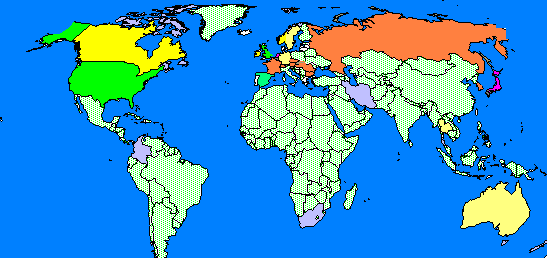 (Click to see map) Technology has also enabled government agents to use these cards to quickly access a wealth of personal information regarding the cardholder. The practice of some countries to include religious and ethnic data on the identity card raises both privacy and human rights considerations. In countries where the adoption of national identity cards have been recently considered, such as Great Britain and Australia, there has been widespread opposition based on privacy concerns. (Click to see map) Technology has also enabled government agents to use these cards to quickly access a wealth of personal information regarding the cardholder. The practice of some countries to include religious and ethnic data on the identity card raises both privacy and human rights considerations. In countries where the adoption of national identity cards have been recently considered, such as Great Britain and Australia, there has been widespread opposition based on privacy concerns.
The U.S. has tentatively entered this international trend with the passage of the REAL ID Act in 2005. Under the provisions of this legislation, federal technological standards and verification procedures were mandated on state driver's licenses and identification cards, many of which are beyond the current capacity of the federal government. States were required to comply by May 2008 but the deadline has been extended. There has been considerable controversy regarding the plan and several state legislatures passed resolutions refusing to implement it based on privacy and cost concerns. However most states have either complied or are in the process of complying. 
Civil Liberty Links
Open Directory - Civil Liberties Organizations
Open Directory - Human Rights and Liberties
Open Directory - Human Rights and Liberties - Free Speech
Wikipedia - Civil Liberties
Wikipedia - Real ID Act
Wikipedia - Identity Document
Wikipedia - United States Foreign Intelligence Surveillance Court
Wikipedia - Sneek and Peek Warrant
Wikipedia - Roving Wiretap
Wikipedia - Guantanamo Bay Dentention Camp
Wikipedia - USA Patriot Act
Wikipedia - Civil Liberites in the U.S.
|
