|
What are the latest developments regarding economic inequality?
The trend toward economic inequality continues in the United States. The Gini Index is at an all time modern high and there is little expectation that this trend will change. 
In recent years the issue has begun to emerge as part of the political discussion in the United States but there has been
no real change in the trend nor in addressing the root causes of the trend. On the contrary, the federal
minimum wage is still quite low and the percentage of workers covered by organized labor continues to decline. As the nation has returned to relatively full employment after the great recession of 2008 and 2009, wages continue to be flat. Similar to other issues such as climate change, the change in economic equality
while profound is a gradual one and thus is not a topic that is frequently in the news. In 2011, an "Occupy Wall Street" movement developed in the country with organized protests in various communities protesting the privileges enjoyed by the top 1% of the population. But the movement was shortlived and it has had no apparent influence on policy.
Why is there concern about economic inequality? Hasn't there always been such inequality?
Economic inequality is indeed a common thread throughout world history. Traditionally, the working class has been poorly protected from exploitation by a numerically small elite ruling class. This situation remains today in most non-industrialized countries.
The political trends of the 20th Century, which were strongly influenced by Marxist ideology, substantially changed this imbalance. For the first time, a concept emerged that workers had a substantial economic stake in their society and that they could personally benefit from their work efforts. A "middle class" began to emerge. This was particularly true in the United States during the post-World War II era where median income levels doubled during a 15 year period. (Click to see chart) Richer and poorer Americans were closer together throughout the 1950s and 1960s and some observers at the time thought class segregation had ended.
This trend has come abruptly to an end. The Census Bureau uses a statistical measure known as the "Gini" index to measure income inequality. The index reflects the rather dramatic increase in the inequality during the past 25 years. The increase in inequality has varied from state to state and, for the most part, has been highest in the more populous states and in the southern states. 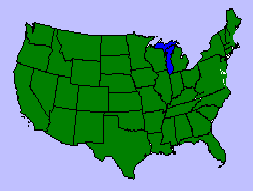 (Click to see map) (Click to see map)
What is truly remarkable is that this change has occurred at a time when overall economic growth has been unprecedented. In real dollars, the GDP has nearly doubled since 1970 but wages based on an index that applies to most workers have actually dropped. Since 2007, the downward trend in wages has particularly affected Americans with lower levels of education. . But the income level of the upper 1% of families has more than doubled and only the income levels of the top 20% of families have significantly increased in the past two decades. The most publicized and extreme example of income inequality has been the rise in compensation levels for CEO's of major corporations.
Economic inequality can also be measured in terms of overall wealth. The imbalance in wealth is far more dramatic than the imbalance of incomes. Since 1984, the share of wealth of the top 1% of the population has increased from 25.4% to 39.6%. The top .01% has 21.6% of all the country's wealth and the top 5% own about 75%. The already small share owned by the bottom 90% has been diminishing. The share of wealth of the top 1% has returned to the levels which existed prior to World War 2.
Many believe that economic inequality is a disturbing trend because of the increasing polarization of what had been an admirably pluralistic society. Income disparities have produced conspicuous consumption among the wealthy and an impoverished "underclass" which includes most recent immigrants and a disproportionate number of African-Americans. There has been a growing "residential segregation" based on income status. America's cities and suburbs are increasingly identifiable by the income group which lives there. The consequences of this economic segregation are significantly reduced educational and vocational opportunities for those in lower income groups. For example, even those low income children who show considerable academic promise tend not to complete college.
A major disturbing byproduct of economic inequality involves public attitudes. Many policy issues draw less consensus opinion because they affect income groups differently. The "underclass", saddled with a negative net worth and minimal income prospects, become resentful of the wealthy particularly when consumption is conspicuous. These attitudes naturally assume a racial and ethnic tone as well. The affect of this trend on the middle class has been more subtle. This group, which is diminishing in number, is far more "status conscious" than in previous decades. The result has been unnecessary consumption, a high rate of debt and bankruptcy. Today, over 40% of the public regards the U.S. as a nation of "haves" and "have nots". In 1988, only about a quarter of Americans had this opinion. 
Have changes in government policy caused increased economic inequality?
Not entirely. But the role of federal policy has been significant. Some of the changes which have contributed to this trend are:
- Tax policy changes
Changes in tax policy, particularly reductions in the higher marginal tax rates, have coincided with the changes in income inequality. For the wealthiest tax payers, the average tax actually paid is far lower than it was in the 1960's and 1970's. Perhaps the clearest recent example of the relationship between changes in tax policy and changes in income inequality is the effect of the Bush Administration's tax proposals enacted by Congress in 2001 and 2003. These changes sigificantly raised the after-tax income of the highest income earners while having a negligible effect on other groups.
- Declining influence of labor unions
In 1960, unions represented almost one third of American workers. Today, they represent just over 10%. In the private sector, the decline has even been steeper. Union membership varies significantly from state to state.
As membership has decreased, so has the effectiveness of union activities. Major strikes have become increasingly rare because employers regularly and successfully replace strikers. In many countries, labor legislation prohibits the hiring of replacement workers. The Reagan Administration's successful repulsion of a 1981 strike by air traffic controllers by firing the controllers and hiring replacements has been regarded by some as a turning point in modern U.S. labor history.
Over the years, employers have become increasingly successful in using existing labor legislation to impair the effectiveness of unions. Unions are virtually nonexistent in some 22 "right to work" states where compulsory union membership in organized industries is prohibited by law. Today unions are rarely capable of mounting successful new organizing campaigns because even if a majority of workers at a site favor a union, workers are forced to go through a slow National Labor Relations Board election process. Employers have become very effective in using these delays to turn around pro-union sentiment.
Unions have long advocated legislative reforms which would simplify the certification process and which would prevent employers from hiring replacement workers. But there has been no substantial progress in achieving these goals.
- Failure to substantially adjust the minimum wage
The federal minimum wage of $5.15, when adjusted for inflation, has steadily decreased during the past two decades and is at its lowest historical level. Moreover, the ratio of the minimum wage to the average worker's wage continues to decrease. Prior to 1980, the annual minimum wage was near or above the Federal Poverty level for a household of three persons. Since 1980, it has been substantially below that level. Over 6% of the national workforce is employed at the minimum wage level. Significantly more low level workers are paid an hourly wage that is scaled to the minimum wage. A majority of states have enacted minimum wage laws which exceed the federal standard. In 2007 Congress passed the Fair Minimum Wage Act of 2007 which called for a gradual increase in the minimum wage to $7.25 per hour by March 2009. .
- Globalization
Many argue that the growing world economy has significantly disadvantaged workers, particularly in manufacturing jobs, because wages are unrealistically low in many countries. They maintain that this has had a negative affect on U.S. wages. But the connection between world trade and wage inequality is not direct. It is the service sector of the economy where job growth has occurred. 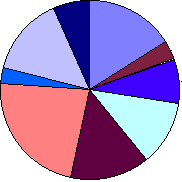 Many low level service jobs have a pay scale which is close to the minimum wage. It is the failure of the economy to provide these workers the protections which previously had been provided to manufacturing jobs that has created much of the wage imbalance. Many low level service jobs have a pay scale which is close to the minimum wage. It is the failure of the economy to provide these workers the protections which previously had been provided to manufacturing jobs that has created much of the wage imbalance.
- Lax governmental regulation of economic institutions
At times segments of the economy which are dominated by wealthy interests have manipulated the political system to achieve major economic gains at the expense of the public in general.
A clear example of such manipulation are the banking scandals of the 1980's. Under this scheme, the government implemented a deregulation plan which permitted banking institutions to offer unreasonably high interest rates to investors. These investors were overwhelmingly wealthy interests who purchased "brokered accounts" under the $100,000 federal insurance limit. The agency responsible for monitoring the investments of these institutions, the Federal Deposit Regulatory Commission, was understaffed and there was political interference with their activities. When numerous institutions failed, the government "bailed out" the many wealthy depositors. The total cost of the bailout according to a recent Federal Reserve report was $153 billion. The net result is a shift of this money from ordinary taxpayers to wealthy investors.
How does economic inequality in the United States compare to other countries? Among countries with modern economies, the United States is the clear leader in income inequality under the gini measure. But recently the overall trend in almost all OECD countries is toward greater income inequality. Income inequality in the U.S. is more comparable to the third world. 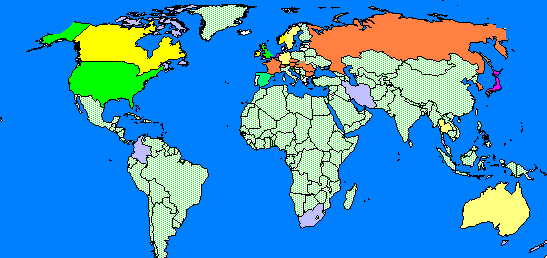 (Click to see map) The percentage of wealth held by the top 10% is significantly higher in the U.S. than in most other developed countries. Interestingly, income inequality does not completely correspond with the density of union membership. The percentage of union workers in other countries varies significantly from country to country yet in countries like France, where there is low union membership, there is a relatively low level of income inequality. Like the U.S., most other industrialized countries have reduced their previously high marginal tax rates in the past three decades. Still, a common characteristic of countries where there is a low level of income inequality is a comparatively high marginal personal income tax rate for wealthy households. (Click to see map) The percentage of wealth held by the top 10% is significantly higher in the U.S. than in most other developed countries. Interestingly, income inequality does not completely correspond with the density of union membership. The percentage of union workers in other countries varies significantly from country to country yet in countries like France, where there is low union membership, there is a relatively low level of income inequality. Like the U.S., most other industrialized countries have reduced their previously high marginal tax rates in the past three decades. Still, a common characteristic of countries where there is a low level of income inequality is a comparatively high marginal personal income tax rate for wealthy households.
Are wealthy individuals contributing more to charity as a result of their increased wealth?
Although the dollar amount of charitable contributions as risen, when compared to the GDP, Americans are giving less today than they did in 1970. Moreover, only a relatively small percentage of philanthropy is devoted to organizations which provide services which primarily benefit the poor individuals who have been most affected by income inequality. Of the religious contributions, for example, the bulk of the funds are used for facilities, operating costs and clergy salaries.
How do Democrats and Republicans vote on issues pertaining to economic inequality?
Economic policy issues affecting the distribution of wealth probably constitute the greatest philosophical difference between the two major political parties. Republicans overwhelmingly support tax proposals which reduce the marginal tax rates on wealthy Americans and oppose tax initiatives which would raise such limits. Republicans also overwhelmingly support full repeal of the estate tax. Republicans stiffly resist most efforts to raise the minimum wage. Even the compromise leglislation which raised the minimum wage to $7.25 in 1979 received significant republican opposition. The major justification advanced by Republicans in support of their economic agenda is that policies which reward wealthy Americans are beneficial for the economy as a whole in that they encourage investment and foster job growth. On the other hand, Democrats who receive all but a very small amount of organized labor contributions support economic policies which primarily benefit wage earners.
Inequality Links
Wikipedia - Economic Inequality
Wikipedia - Minimum Wage
Wikipedia - Progressive Tax
Wikipedia - Trade Union
Wikipedia - Gini Coefficient
Wikipedia - Distribution of Wealth
Wikipedia - Wealth Inequality in the United States
Wikipedia - Wealth in the United States
Wikipedia - Redistribution of Wealth
Demos
United for a Fair Economy
National Bureau of Economic Research
OECD (an international organisation helping governments tackle the economic, social and governance challenges of a globalized economy)
PBS - American Century - Money
Economic Policy Institute - Inequality and Poverty
|
